Please Support me in the Fight Against Multiple Sclerosis!!!


Visit my Personal Page as I raise $500 for the National MS Society. On June 29-30, I will tackle the MS 150 Cape Cod Getaway in support of this cause. But I can't do it without you! Please help me get to the starting line, and I will do the rest!

A big thanks to Team Summit for taking me on as a new team member. With their help, I know I will have the on-the-road support I need to get all 150 miles from Start to Finish!

Thursday, March 24, 2011

"Always Be Epic"

Epic [ep-ik] - adjective: 1. heroic; majestic; impressively great. 2. Of unusually great size or extent.

It is with that in mind that I introduce you to:
Alway Be Epic
What is the Epic Man?  I'll let them explain the details.  But, as a synopsis, two friends created a challenge that each refused to back down from.  Thousands of people run the Boston Marathon - but does anybody do it as part of a triathlon?  Enter, the Epic Man.  Now in its third year (and incarnation), Epic Man involves running, kayaking, swimming, cycling and, of course, eating and beer drinking.  The first year started one day before Marathon Monday and involved a kayak from Peaks Island off the coast of Maine, an overnight bike from Portland, ME to Hopkington, MA, and a running of the Boston Marathon.  Amazingly, it has only since grown and now benefits six separate charities.  

This year's adventure is one of... well, epic proportions, naturally.  In addition to the kayak/bike/run in New England, the Team (which has grown from the original two founders) will spend the weeks prior venturing to Milwaukee, biking to Chicago, giving a lecture in Albany and running through Manhattan in a path that spells the word, "EPIC," among other things.  The graphic below highlights the schedule, and you can read a detailed schedule on their website.  Did I mention they are also skydiving??

Check Please!
So, why am I writing about these guys?  A few obvious reasons, and a few not-so-obvious reasons.  First, the most obvious: this is probably the coolest thing I have ever heard of.  Forget the Warrior Dash (which I am doing) or the Tough Mudder (maybe next year).  These guys blow that out of the water.  But, it's not about being better, or crazier, or harder than anything else.  It's about being EPIC, whatever that means to you.  I could never speak for the people who created this, but they write about inspiring others to "be epic" in their own right.  We used to have this cheesy saying in high school about "pushing (our) comfortable limits" in order to grow into a better person.  This is an embodiment of that.  It is also a lesson in overcoming obstacles that is played out in the training and execution of this event, as well as in the charities it supports.  Read about last minute changes to last years event due to the erupting volcano in Iceland, and then read the story of Josh, who was the recipient of the first Epic Wish, allowing him to have his own Epic adventure - you will be awed by both.

The not-so-obvious reason I am writing about this is that I have the pleasure of joining them for part of the adventure!!  As everyone is WELL aware, I have been training for the Zimmerman MS 150 from Miami to Key Largo, where I bike 150 miles to raise funds for the research and treatment of Multiple Sclerosis.  It takes place in mid-May, and since I am doing all of my training up north, I have been hard-pressed to find a good training ride to do before the MS Ride.  Enter, the Epic Man.

As part of the Portland to Hopkington overnight ride, waves of cyclists are going to join Epic Man on the Portland, ME to Portsmouth, NH leg of the journey (about 50 miles).  This portion is sponsored by Trek Portmouth, and you can join in the fun by contacting Olivia.  There isn't even a registration fee!!  When I spoke to Olivia, she asked that in lieu of a reg fee, a donation ($20 was suggested) be made to Team Trevor, which is the beneficiary of this part of the Epic Man.  I actually just took a break from writing this entry to make my donation.

I have been trying desperately to get as much cycling in as possible, but since it's now less than a month until this event, I have more motivation than ever.  I'm beyond excited to have a small part in something so amazing, and I hope you, dear reader, are able to join, support or party with Epic Man at some point in their weeks-long journey.  Be sure to check out their blog and Facebook page for updates, and I hope to see you at the beginning, end, or somewhere along the route!!

Friday, March 18, 2011

A Little Friday Inspiration!

For me, Fridays are the toughest days to get a workout in.  On Monday, it's the beginning of a new week - it's all out in front of you, and you know what to expect.  I have work these days, workouts these days, etc.  By the time Friday's run rolls around (I do a 10K every Friday), I've been up before dawn 5 days in a row with a 6th looming, as I train clients every Saturday morning.

It is with that in mind that I sit here, trying to motivate myself to hit the pavement.  Perhaps you're having the same trouble, too?  Whenever you read this, maybe you are procrastinating on something else you should be doing?  Don't get me wrong, I would love for you to read my blog!  But - save it for after your workout.

I stumbled on these two videos earlier this week, and today they are my motivation.  I would like to share them with you, and I hope you find that these move you, both emotionally and physically, they way they moved me.

The first is a video of Team Hoyt, made up of Dick Hoyt and his son, Rick.  There are no words in this video and there don't need to be.  Many of you may be familiar with this story, but for more info, feel free to go here and read up on them.  Team Hoyt was at the Hyannis Races that I did back in Feb.  Unfortunately, I did not see them while I was there, but I can only imagine what it must have been like given the big fat snowflakes that fell for most of the race.


And if that isn't inspiration enough (and I'm sure it is), I thought I'd add this in as a bonus.  Sister Madonna Buder, otherwise known as "The Iron Nun," recently came to my grad school Alma Mater, Barry University, to speak on her experiences as a triathlete.  Sister Buder turns 81 this July and just released a book about her experiences as an athlete.  It is next on my book list!


Have a happy, healthy, productive and enjoyable Friday!!

Monday, March 14, 2011

The Best Injury Treatment is Prevention

...and "Balance" is the best form of prevention.  Let me explain.

Chance are, you have heard maxim that is the title of this article before, along with pearls of wisdom like, "An apple a day keeps the doctor away!" and "An ounce of prevention is worth a pound of treatment!"  It is likely that all of us, on some level, know that preventing something bad (or injurious) from happening is far, far better than dealing with the aftermath.  This is why there are seatbelts, airbags and auto insurance, but we still require everyone to attend driving school and take a test to obtain a license.

Intuitively, we get this.  So why am I talking about it?  Because most of us are very, very bad at it when it comes to our own bodies.  This is especially true if we don't like something that is good for us, like healthy food or exercise.  We become very choosy about what we will and will not do in order to maintain health or improve performance.  This is why I know people who won't eat certain foods because they are bad for them, but are in the bars every weekend.  It's not that they're misinformed, it's just that they are willing to compromise on only so many things.  Think you don't know someone who does that?  Look in the mirror - we all do, in some fashion, and I will be the first to raise my hand and say I am guilty of drinking Diet Coke (lower calories, no high fructose corn syrup) but scarfing down far too much ice cream.

But it's not just diet (which is only one part of healthy living).  When I speak about prevention, I'm talking about the things we can do to maintain an active, healthy lifestyle.  Here are a few things that will all help us be better, healthier, active adults.

*  Do the things you don't like.
    Most workouts will include some aspect of the following, with one probably being a main focus: mobility, stability, strength, and conditioning.  It is likely that you hate one of these things, or at least part of one of these things.  For me, it's the dynamic warm-up.  I'll foam roll all day, but after that I just want to get under the bar or out on my run or bike route.  So, why not just skip it?  PREVENTION!!  (Remember??)  If I skip the dynamic warm-up, my program is lacking a vital component.  The warm-up is what allows me to lift as well as I do or run without being injured, as I wrote about last week.  So, while I find it irritating, I know that it actually makes me a better lifter, runner and cyclist.

*  Do things that are hard.
    We do easy things all the time.  We do hard things a lot, too - I will not take that away from you.  But, when it comes to the gym, we need to make a commitment to the hard stuff.  I struggle with rotational stability.  I can hang clean with the best of them, but ask me to chop and lift and suddenly I'm a new fawn, all wobbly and soft.  Because it is hard for me to do, it's easy to skip it - but it being hard is precisely the reason I need to work on rotational strength more, not less.  It's hard because it is my weak spot, which means I am susceptible to energy leaks and injury.  Find what is hard for you and become a master at it.

*  Once in awhile, do something when you don't want to.
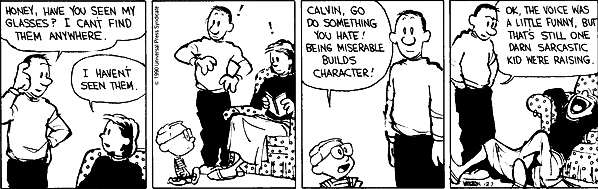
    This is a tough one.  If we are lucky, we are doing what we want to do for the majority of our waking hours, making the occasional push to do something unpleasant (but beneficial) a little easier.  If we aren't so lucky, we spend a lot of time (perhaps at work or in school) doing something we don't really want to be doing.  I am always reminded of the dad from the Calvin & Hobbes cartoon, who is constantly trying to get Calvin to do something he doesn't want to because, "...it builds character."  At the risk of sounding like a parent, that guy was onto something.  In fitness, we tend to do the things we enjoy doing.  I became a runner basically because I hated running.  Yes, that's counterintuitive.  I've been athletic and active my entire life, but I wanted a new challenge that fit into my current lifestyle - running fit the bill.  Sandwich one thing you don't like (say, Mountain Climbers) between some things you do like (front squats and Turkish Get-Ups, obviously) - you get the idea.  You will find there is a special satisfaction in completing something you're not thrilled about doing in the first place.

       Source.

*  Once in awhile, don't do something when you do want to.
    I put this in here as a reminder that recovery is important.  While for some of us the issue is not moving enough, for others the issue is slowing down.  Running through injury, lifting when sick, or just plain working out every day of the week without a break will only lead to breakdown in the end.  Go have fun!  Yes, working out can be fun.  Go do something else that is fun (Dear Red Sox, Please feel free to help me avoid injury by giving me tickets to a game a week so I have something fun to do other than working out.  Love, Me).  Speaking of fun...

*  Make a commitment... to doing something FUN.
    In reading through my list of the first four, it sounded a bit like a manifesto on how not to enjoy life!  Nobody wants to be forced to do something they don't like or that is hard all the time.  Likewise, we don't want to take away the things we enjoy.  That's why working activity into your life in ways that bring other forms of enjoyment is important.  I could run just to run - for the health benefits or whatever.  But, I run road races because I get further enjoyment out of the inner (and occasional outer) competition, the camaraderie of "we're all in this together" and the social aspect of having a post-race pint.  Beyond running, this activity brings me joy.  Do exercise and fun coexist in your life?

I opened the blog saying that balance is the best form of prevention.  Living a balanced life will enable you to stay healthy and realize your full potential.  Work and play.  Activity and rest.  Flexibility and strength.  Mobility and stability.  We need all of these things to be complete.

On a personal note, the last few weeks have been a bit of a roller-coaster in the lives of people I know.  Two untimely deaths have been met with a birth and a wedding - and with these events I have witnessed utter despair and unbounded joy.  In this moment I am thankful for the people I love and who love me, for the opportunities I have and create, and for the ability and drive to be better and move forward, however incrementally.  As my RoadID says, "Momentum trumps inertia."

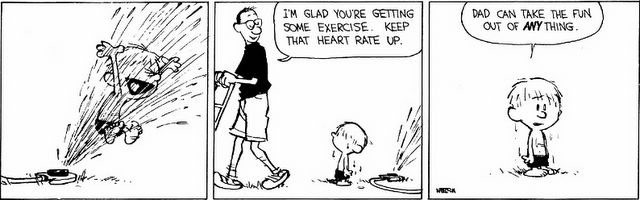
I thought I'd leave you with another Calvin and Hobbes strip!
"Grown-ups play by justifying it as exercise and keep tabs by quantifying performance."  Source.

Monday, March 7, 2011

How My Warm-Up Saves My Ass (Literally)

A little while ago, I was browsing the interwebs, and I stumbled on this article: "When the Diagnosis is 'Dead-Butt Syndrome'".  After the obligatory giggle, I read through author Jen Miller's account of being diagnosed with gluteus medius tendinosis, sometimes referred to as "dead-butt syndrome."  With or without the -osis (indicating an inflammation of the tendon sheath) attached to it, gluteus medius weakness is absurdly common in endurance athletes - particularly those who do only one sport, and especially in runners.  The third paragraph nails it: "It's a symptom related to what running experts hammer at: the need for cross-training and strength training."

Which brings me back to the Hyannis races that went on last weekend.  Prior to the race, I was doing a dynamic warm-up.  I find that I am always the only person doing this, and I get a lot of funny looks (it's okay, I'm used to that).  Some people "warm-up," of course, by static stretching and running around a bunch to get the blood flowing and practice their stride.  As far as neuromuscular facilitation, or movement preparation, or functional movement warm-ups, though, it is non-existent.  One experienced runner commented, "Um... you make me feel like I should be doing something.  I don't warm up.  I just run."  Another wandered by while I was doing body-weight squats and said, "The real challenge is to see if you can still do those after the race!" (Result: I could, though not without some grimacing).

There has been increasing coverage in the general media about the dangers of specialization, especially in children, and how doing one thing all the time can lead to very serious injuries.  Runners for some reason think they are immune to this, and I have yet to understand why because they are plagued with injuries. Now, I am new to this whole "being a runner" thing, so maybe I just haven't drank the Kool-Aid yet.  However, my background is in athletics, injury, biomechanics and sport training.  I would never assume to know everything about anything, but I've had a pretty solid success rate at both preventing and treating injuries in many clients. The ultimate test, though, is with myself.  How many self-proclaimed experts do we know who don't actually practice what they preach?  Heck, I'm guilty from time-to-time (Ice cream before bed?  Yes please!)!  But, on this front, I'm one of the best - the only injuries I've ever sustained were spraining each ankle once, and both were because I fell down a flight of stairs (yes, each ankle once, fell down stairs on two separate occasions... because you can't strength-train the "klutzy" out of your DNA).  I have never sustained a major competition- or training-related injury (though I *have* sustained a "lack of training" injury in my two bulging lumbar discs... more on that some other time).

How do I do it?  What magic elixir am I taking??  It must be L-glutamine, right?  Or glucosamine?  Or protein shakes?  Or maybe I just don't train that hard - that must be it, right?

Wrong!  Though I may not be running marathons right now, guess what?  You don't have to be training for a marathon to get hurt... but you knew that.

The best part is, it's simple - and I'll give it to you right here.  I am currently training for both running and cycling events.  I run three days a week at steady mileage to maintain the gains I've made, but I don't need to increase right now because I am not training for a farther distance than I've yet achieved.  I bike three days a week at varying, progressively longer distances.  These activities overlap on one day, so I train 5 days a week with two for "rest," but that is an active rest - these are days when I am working both jobs and just don't have time to get a run or bike in, but since one job is at a gym, I am able to do a few basic movements for recovery.

With all that time for training, it sounds like there's not a lot of time for that all-important cross-training I've been harping about, right?  And that's where the warm-up comes in.  One part Renegade Training, another part Mike Boyle Strength and Conditioning, I spend between 15 and 40 minutes (depending on the day and the activity) getting my body ready for what I'm about to do.  The major takeaway here: nearly all these exercises emphasize hamstring development and the "turning on" of the gluteal muscle group.  Why does this matter?  I'll tell you in another blog.  For now, the components of my warm-up:

*  Foam Roller - Don't leave home without it!!  I spend between 20-30 seconds each on my glutes, hamstrings, thoracic spine, IT bands, hip flexors/quads and adductors.

*  Posterior chain activation and core strength - Variations of bridges, tables, planks and Supermans (with a few push-ups thrown in) to get my core activated and ready to stabilize my hips, pelvis and back during my bike/run.

*  Dynamic ROM (range of motion) - Split squats, lateral and transverse lunges, as well as single-leg body-weight Romanian deadlifts and body-weight sumo squat "stretches."

*  Movement Prep - Walking lunge progressions, skips, butt-kicks.

For more specific info, hit me up with questions.  Happy Training!!

Tuesday, March 1, 2011

Running Gently, Part 2: I Get (a great finishing time) With a Little Help From My Friends!

I successfully completed my first 10K!!  I slogged through the snow, slush and ice to cross the finish line in a dead-out sprint for an official time of 55:21 (my goal was under 56 min).  The photo above gives you an idea of the weather (a wet snow fell the entire time)... ahh, racing in New England.  And you better believe there were people out there in shorts and tank tops!

I could not have run as well as I did, however, without the help of a seasoned marathoner who paced me for the first 5 miles, until our routes split.  The concept of pacing has been a difficult one for me, particularly over rolling hills where I want to charge up them, just to get them over with.  I use this approach in cycling a lot, but the difference is that you can't stop pedaling and coast for a bit when your feet are your wheels.  So, my "Run Sherpa" kept us around a 9-min pace, which she seemed to just know intuitively - something I don't quite understand but am thoroughly amazed by.  Practice, practice...

So, how was my form?  Did I "run gently?"  What does that even mean??

If you were trying to sneak up on somebody, how would you approach them?  Perhaps on the balls of your feet, carefully stepping to make as little noise as possible?  While good runners aren't exactly tip-toeing along, they are using the balls of their feet and their toes to drive them forward, and they are quiet.  Start listening when people run by you, or you are out running.  Is there a shuffle sound?  Does the shoe slap the ground (mine does, but I'm working on it...)?  Or is it nearly silent?  Gentle, and efficient, runners - even those who have not perfected that gazelle-like, beautiful form we all long for - are very quiet with each step.  Heel- or midfoot-striker, it will not matter.  They will breeze over the ground like they are floating.

Which brings me to the next aspect of gentle running: translation direction.  Most daily activities find us moving in some combination of the planes of movement, but in running, one of these should be dominant.  The goal of endurance running is simply to propel oneself straight forward in the most efficient way possible.  There is an important word in that sentence: forward.  Bipedal locomotion - walking and running forward - is what we have evolved to do.  And, yet, sometimes we are so bad at it!  It's almost as if we want to make it more complicated, or more exciting.  "It can't just be, 'Go forward,' can it?  There's gotta be more to it."  No, there isn't.

Why am I harping on this?  Because a huge tenet of running gently is running forward - NOT up-and-down.  I just watched some of the NFL Combine where I caught the linebackers doing the 40-yd dash.  Once these athletes were out of the starting gate, you could have put a roof an inch above their heads and they would never touch it.  When the goal is forward, up-and-down is wasted energy.  However, it is a common "coping mechanism" among novice distance runners.  My educated guess is that it's an unconscious way of pacing themselves.  Whereas fully forward motion might be too fast for the distance they are running, adding the "bounce" to their step is certainly going to slow them down - but it is also going to hemorrhage energy and possibly lead to injury.  This is a problem I am very familiar with.  As I mentioned previously, it is only recently that I have figured out a way to slow myself down without completely changing my biomechanics (smaller strides, increased frequency).  Prior to that, I was running with a sprinter's form and trying to keep a 10K pace, but I would fatigue after 2 miles because I was always running faster than I should have been.  And a long, long time ago, I was the bouncer - using my legs to absorb energy (and eat speed) by flexing my knees with each foot strike, making every step a poorly performed mini squat I would have to rebound from as I tried to continue forward.  No wonder I thought I wasn't built for this sport!

So, to run gently, we must 1) tread quietly, 2) pace ourselves with the right cadence and stride length for our body type and the distance we are running, and 3) go forward.

Pay attention to those three things on your next run (or while your athlete/client/friend/significant other/neighbor/stalking target is out for their run) and see what you come up with.  Do you run gently?

In the next few posts: How my warm-up saves my ass (literally); Prevention is the best injury treatment; Point/Counterpoint, where I argue with myself about orthotics and minimalism.  Stay tuned!

Wednesday, February 23, 2011

Running Gently, Part 1

Two things happened yesterday:

First, I ran 4.3 miles.  This is (sad to say) the farthest I have ever run consecutively.  As in, I didn't stop, I did it on purpose, and I did it as a part of my training for the 10K I have Sunday and my eventual half marathon.  I also did it outside - I don't have access to a treadmill right now, so I'm out pounding the pavement, no matter what the weather.  Turns out today was quite nice, despite not getting very far into the 20's (that's below-zero in Celsius, for all my international readers!).

Second, I started my new internship at a footwear company.  It will not be possible to convey my excitement about this.  For the next 3-6 months, I work in the sports research lab, where I will learn everything I could have ever hoped to know about shoes and shoe construction.  I literally use a saw to cut shoes in half, and then in half again, in an effort to understand what goes into their construction, right down to the last detail (pun intended, for those who know shoes).

What does my day have to do with running gently?  Well... everything.

In addition to the actual research that comes out of a corporate sponsored research lab, it's a pretty neat stop on any guided tour.  Apparently this happens all the time, and yesterday was no exception, as we hosted a large group who does business with the shoe company.  While they are being shown the lab's capabilities, they have the opportunity to ask questions.  One astute participant asked about running form, and if the lab had any empirical data to support the superiority of a mid-foot foot-strike.

My colleague's response so so well-put I found myself wishing I'd had a video camera set up to capture it.  In essence, the research lab has not yet had the opportunity to assess the "superiority" of any particular gait pattern.  A quick review of th available literature suggests that not many others have attempted to answer this question in any resounding manner, either.  He continued, (and of course I am paraphrasing) "The variability of each individual's body type, morphology and individual physical characteristics probably means that there is not any one way that is the right way to run.  This is true of all our research.  When we created (a product), we wanted to know, how does this feel to a majority of people?  Not, 'Does this work for everybody?', because nothing will never be right for everybody.  But, can we manage to provide something for the majority of people who might be interested in it?"

Another colleague chimed in, citing Christopher McDougall, who I referenced in my last blog post.  He mentioned how in McDougall's case, he had tried many, many different options to run comfortably and without injury, all to no avail.  "In his situation, where he has tried just about everything without any success, well then maybe it makes sense to do something completely different - like run barefoot, or in minimal shoes."

While it is a virtual certainty that there is not one correct way for everybody to run (the concept of variability), it is equally likely that it is possible to change your running form (the concept of adaptability).  In fact, it is already known that, like any exercise program, a running program designed to specifically alter your gait in one way or another can be successful - and the empirical evidence will probably be published to back it up soon.  Once again, while this may not be the right idea for *everyone*, it is probably a good idea for some people.

Like me, for instance... which brings me to yesterday's run.  I have always been a sprinter (see my first blog where I begrudgingly admit to transitioning into being a "runner" now).  I train for power.  I know that the more force I put into the ground, the more ground reaction force I get out of it - the harder I push off the ground, the higher I can jump.  Unfortunately, this has not translated well for distance running.  My feet slap the ground with the grace of a drunk clown chasing down children.  My strides are long, because I am used to having short bursts of speed and reaching with my feet, as you do while dribbling a soccer ball (pushing it out in front of you) or challenging an opponent.  These techniques lead to some serious inefficiencies when it comes to endurance training.  Thus, I have consciously worked on adjusting my stride to one that allows me to run longer without sacrificing too much in speed.

In this way, I borrowed the methodology of cyclists, a sport which I am a bit more familiar with (and better at, if only marginally).  Lance Armstrong, among others, advocates using higher gears ("easier") and an increased tempo, somewhere around 90 beats a minute (45 revolutions per foot).  With this in mind, I shortened my stride and increased my tempo - hitting the ground more often but not traveling as far with each step.  I haven't broken down the biomechanics of it yet, but so far it's been successful cardiovascularly.  I can run farther, with roughly the same overall pace, but my heart rate stays lower and I don't feel as "gassed" as I typically do, especially on hills.  My legs also feel stronger throughout the entire run.  In some way, I have found an efficiency increase.

I practiced this on yesterday's run, with great success.  However, by the time I was finished I was having terrible hip pain over both my IT bands and in my right hip flexor (where I've had previous trouble).  I believe it leads back to the concept of "running gently."  Though I promised a conclusion to this discussion in my last post, I will have to put it off for one more entry... I don't want to be late for my other job!

Next time:  Landing postures, warm-up and strength training... How these things have helped me be successful and injury-free.

Saturday, February 19, 2011

"Proper" Running Form?

I've had the flu for 6 days, and I am happy to report that I am finally on the mend.  Fortunately, I was sick during a week where my work schedule was light and I had a lot of free time.  Unfortunately, I had planned on using that free time to train for my upcoming 10k in Hyannis next weekend.  Next week I am starting two new jobs... and still working the old job.  That means that when I run the 10k, the farthest training run I will have logged is 3.6 miles, and it was over two weeks before the actual race.  While this is not a training mechanism I would recommend to anyone (and one I will not employ in the future), I am nonetheless going to run the race, come hell or high water!!  I may not finish in record time, but I will finish.

In the meantime, I wanted to build on my last blog, where I started to discuss proper running form.  As I mentioned, running shoes have taken a lot of blame for the gait of many of today's athletes.  As Townsend pointed out in the article I linked to, until very recently all athletic shoes were built with cushioned heels that were designed to reduce impact forces during heel striking.  This leads to a "chicken-or-egg" scenario: Did running shoe companies provide cushioned heels because athletes were hurting themselves while heel striking and needed such cushioning?  Or did athletes begin heel striking with the creation of shoes that allowed them to do so?

Before I answer this question, I want to point to another blog post, by RunBlogger's Pete Larson.  Larson is a biologist, and in his post, he brings up a point that anyone who has ever done a science experiment is familiar with: variability.  As a biologist, Larson has come across variability in his research, and his knowledge of the world around us leads him to believe that the same variability he finds in other organisms probably exists in humans.  He is, in fact, correct.  While we often hear that there is one "correct" way of doing something (for instance, how to squat), the truth is that humans have a high amount of variability between them, and even within them.  In the RunBlogger post, there is a video of 4 of the top 5 finishers at the 2010 Boston Marathon.  Even among these elite runners, there is variability in all aspect of their gait.

Back to the heel striking question: were shoes designed because we were heel strikers, or did we become heel strikers because of the way shoes were designed?  A quick personal anecdote gives you my answer.  I have used a wide variety of athletic footwear in my life, at one point wearing orthotics and motion-control shoes, and at others wearing minimalist shoes.  All other factors aside, when I run in minimalist shoes (ones with no cushioning or drop, like the Vibram Five-Fingers), I am physically unable to run with a heel-strike.  Simply put, I'd break my calcaneus (or at least bruise it really badly).

So, most people were probably running with a mid-foot or fore-foot strike prior to the introduction of cushioned athletic shoes.  *But,* and this is important, how do we know that this was the "correct" running form?  Just because it was how people were running before technology allowed them to change does not make it the "right" way - it was the only available way.  There was no other choice!  Could it be possible that, at least for some people, heel striking is actually a more natural running pattern, and these shoes now allow these people to run more comfortably?

Many people point to Christopher McDougall's book Born to Run and the story of the Tarahumara, a people left untouched by modern society.  In short, without any modern amenities whatsoever, a tribe of people run as their only means of transportation, sometimes hundreds of miles a week.  Despite the fact that they live in the woods and have little more than rawhide to cover the soles of their feet, running injuries and "overuse" injuries are nonexistent.  McDougall has made a career out of the idea that going barefoot is the way to freedom - freedom from pain, injury and the cost of useless technology that is, at best, not helping us and at worst, actually causing injuries.

Could there possibly be another explanation for all this?  The Tarahumara run.  That's what they do - that's how they get around.  Seems pretty obvious that they would have adapted well to not getting injured from running when that's how they survive.  But you and me?  We run for fun.  I'm willing to bet that while awake, dear reader, you spend at least 50% of your time seated (and the only reason I'm not guessing higher is that I know some pretty active people).  Do you work on a computer?  Drive a car?  We ALL do.  It's a part of modern life!  And guess what, there are consequences for our bodies that come along with that.  Just like our bodies would adapt if we ran all day, every day, our bodies have adapted to being awfully sedentary.  Though I am not saying this is a good thing, I am saying that along with variability between and within individuals, I can also guarantee the human body's ability to adapt.

So.  We've been running in cushioned shoes for roughly 40 years.  We've been in increasingly sedentary jobs for about the past 30 years.  We've moved from an industrial economy to... whatever it is we are now - certainly, computer-based and consumer-driven, but certainly not factories and brick-and-mortar.  Does anyone personally know a farmer?  Does that farmer hoe his own land, or does he ride a giant tractor?  You get my drift.  Could it be possible that our running form - whatever our personal running form might be - has degraded due to a confluence of factors?  Even McDougall says, "But ultimately, the debate isn't about Bare Soles vs. Shoes.  It's about learning to run gently.  Master that, and you can wear - or not wear - anything you please."

More on running gently in the next post...