Please Support me in the Fight Against Multiple Sclerosis!!!


Visit my Personal Page as I raise $500 for the National MS Society. On June 29-30, I will tackle the MS 150 Cape Cod Getaway in support of this cause. But I can't do it without you! Please help me get to the starting line, and I will do the rest!

A big thanks to Team Summit for taking me on as a new team member. With their help, I know I will have the on-the-road support I need to get all 150 miles from Start to Finish!

Friday, June 14, 2013

Open Letter to Cubby Tees re: "Chicago Stronger" Shirts

To Whom it May Concern:

I saw last night the reports of a Chicago Stronger shirt.  Initially, my reaction was, "Not cool, bro."  To me, it felt like the co-opting of a rallying cry meant to unify a city after an awful tragedy, and using it as an opportunity to take a poke at MORE than the Bruins, but at Boston itself.  After all, "Boston Strong" is not about the Bruins, specifically.

I slept on it, and today I read through the response on your website after halting sales of the shirt.  

On the one hand, we agree on this: "Boston Strong" has been co-opted by others.  It has been used by companies in- and outside the Boston area for profit, rather than to benefit victims.  It has been applied, to a lesser extent, by a few Boston sports fans as a "Us vs. Them" rallying cry.  There was even a for-profit t-shirt stand selling "Boston Strong" shirts outside the TD Garden (where the Bruins & Celtics play) before The One Fund Benefit Concert, and fans bought them thinking they would benefit the victims.  It is not right.

While I have not met ALL your requirements prior to writing this email (I did not donate blood Marathon Monday because I had actually run the Marathon and was trapped near the finish line next to the medical tent when bombs went off and everything went on lock-down), I feel that the following is worth your consideration.  

1.  To my knowledge, the Chicago Stronger shirts would not benefit The One Fund.  Please correct me if I am wrong, but I couldn't find anything that indicated proceeds would be donated anywhere on your site, even when the shirt was still for sale.  This makes you at least as bad as those you are "parodying."  Your "holier than thou" response indicates that you feel no need to donate to the One Fund due to it being well-funded already (please see below for thoughts on that).  However, even if The One Fund had an Austin Powers-style *ONE BILLION DOLLARS*, you are using the existence of "Boston Strong" - intended to benefit the One Fund and victims of the Boston Marathon - to benefit yourself.  At minimum, you should be donating the profits somewhere; and without a Chicago-specific tragedy on your hands (despite asinine empty threats of other reactionary Bostonians, I wish you nor your city any harm), the right place to send it is The One Fund.

2.  The One Fund, if you have been paying attention, is NOT "very well endowed."  Please research the cost of prosthetics, and how often they need to be replaced, and multiply that out over a lifetime, and then let me know what number you come up with.  What The One Fund currently has is enough for one payout to each victim.  There are over 200 victims.  Evenly split (which it won't be, by necessity), that is around $200,000 per victim.  That may cover prosthetic limb costs ($10-20K each, needs replacing every 10 years).  What about converting a home to be accessible?  What about lost wages, now and in the future?  Future health complications that accompany such injuries?  Costs associated with quality-of-life concerns?  The only people who will "profit" off the Boston Marathon bombings are companies like yours - certainly not any of the victims.  Further, I feel pretty safe guessing that any one of them would take back their skin, or their legs, or their lives, if it meant not having a single dime.  But, since that is not an option, they deserve as much support as can be mustered - and anyone associating themselves with the Boston Marathon bombings (by using "Boston Strong" or a variation) should be committed to using any money generated to help.  Like it or not, the phrase has entered the common vernacular and is irrevocably linked to what happened that day.

3.  The very clearly sarcastic and snarky tone of your response on your website is disappointing.  Guess what - the internet is full of idiots.  The whole world is full of idiots, in fact, but the internet brings them right to your doorstep to blather on monosyllabic-ally about whatever enters their so-called brains.  And you fell for it.  Rather than taking the high ground, you further insulted Boston by assuming that all the invective you've been receiving is representative of ALL Bostonians.  You say, "We believe that the majority of noble Bostonians have the proper perspective and priorities", but follow that with two qualifiers: that "noble" Bostonians are the ones who AGREE with your "position" (i.e., selling those shirts), and that the remaining "sizeable contingent" are vulgar, violent, hypocritical, and racist.  

Based on your requirements for emailing, here are some questions for you regarding your response: Have you spoken to ALL Bostonians?  Have you personally contacted victim's families to ask them how they feel about the Chicago Stronger shirts?  Or even about the Boston Strong shirts?  Have you talked to ANYONE from Boston?  Have you called a company making Boston Strong shirts and asked them how their business model went and what the best way was to do this?  Do you know where the term "Boston Strong" originated, and how much it has helped victims and their families?

4.  Chicago has it's share of championship winning teams, and it's own "lovable losers," the Cubs.  As a once long-suffering (Red) Sox fan, I feel for every Cubs fan out there.  Based on the name of your company, Cubby Tees, and the merchandise you supply (all Chicago sports teams, including college) there appears to be no separation for you between "Chicago" and "Chicago sports teams."  That's pretty normal stuff - after all, don't our sports teams represent our cities?  Why else are they called the CHICAGO Blackhawks or the BOSTON Bruins?  They are inextricably connected (just ask a Brooklyn Dodgers fan).  The Boston Marathon, while an international event, is uniquely Boston.  Have you experienced Marathon Monday?  Do you know there is a home Sox game every year at 11am on Patriot's Day (Marathon Monday)?  Do you know that, for the past few years, there has also been a home Bruins game that night (which was cancelled this year)?  Chicago and Boston are quite similar in that way - sports, politics, and food are woven into the city's identity.  Is "Boston Strong" meant to be a rallying cry for the Sox, or the Bruins, or any other Boston sports team?  No - it is a rallying cry for the city itself, for the citizens here who experienced something terrible. Guess what - I was also at the first Bruins game after the bombing, the one where the crowd sang the National Anthem together and there wasn't a dry eye in the place (watch that and try not to get goosebumps - I know how the Hawks fans like their National Anthem).  During the game, instead of the usual "Let's go Bruins" chant, it was "We love Boston" and "Let's go Boston."  All night.  The Bruins WERE Boston, they represented all that was right and normal and great about our city.  They provided fans with a sense of normalcy and joy (even though they lost a close game) at a time when they needed it most.  I would think the Blackhawks, or any other sports team, would want to be able to do the same for the place they call home - and it IS home for many of this Bruins team, which has a lot of players who live full-time, year-round in Boston.  So maybe "Boston Strong" isn't and should not be synonymous with "Bruins Strong," but the sentiment of cheering for something that represents something you care about - home - is one I'm sure you can understand.  Someone attacked our home - not your home - and that is an effect only Bostonians can understand.  Bottom line: Regardless how you feel about "Boston Strong" used as a sports chant, using it as a jumping off point for your OWN sports chant - or, more accurately, as a way to sell merchandise - is at best short-sighted, and at worst classless and downright cynical.  

"Boston Strong" is the epitome of hope.  Try not to dump on that any more than you already have.  Fortunately, I know that Chicago is full of its own strong citizens who - unlike your company - do not need to use a gimmick based on a perceived slight that grew out of a populace's response to horrific circumstances in order to show their support for the Hawks.  Regardless of who takes home the Cup, the people of Boston and those from elsewhere who were there for the Marathon will continue to rebuild their lives, knowing that they have the support of millions behind them.  I believe they would be just fine if Cubby Tees was not among them, but if you ever have an urge to truly experience this city, I assure you we will welcome you with open arms.

Go Boston,
Erin Learoyd

Tuesday, May 22, 2012

Parades, Bears, and Everything but the Kitchen Sink

...oh wait, we had that, too.

Welcome to Chelmsford!
On Saturday, I (somewhat) successfully completed my first ride with friends.  This doesn't sound like that big of a deal - I mean, what isn't better with your friends??  And, in truth, it was better with them - but that didn't mean there wasn't a whole lot of anxiety leading up to the ride.  Of the 3 people I went with, two have been cycling for months, and the other is actively running marathonS.  (Capital "S" on purpose.  MarathonS!).

Needless to say, the first thing I did was get us lost.  Pro-Tip #1: If you think your exercise app has GPS that gives you directions, try it out before you embark on a 26+ mile trip in an area no one is familiar with.

37 miles later, we rolled back into the parking lot where we started, grimy and gritty from being on main roads, a little unsteady on our feet (well, I was).  One friend hopped in her car and took off like we'd just spent the afternoon lunching and she was off for some shopping and spa treatments.  As I'm leaning on my car, bargaining with whatever deity you believe in to pick up my bike and deposit on top of my car on my behalf, my friends are laughing and walking around like someone didn't just triple gravity.

Oh well - there's something to be said for going above and beyond your goal (25-30 miles), even if it was accidental.  We got lost many times, not just as we were leaving the parking lot, but that led to a few adventures.  For instance, we biked through an oncoming parade.  We also pulled over on a back road to check our map, and a woman walking with a baby told us, in all seriousness, not to go down a road because there were bears.  Then, she walked down that very road.  Maybe she's not afraid of the bears, and actually lives peacefully among them - who knows?  Pro-Tip #2: Don't get eaten by bears.  We moved on.

Not pictured: the gaggle of baton-twirlers in pink dodging in
and out of our way , and the bear who later ate them
It might have taken us 3.5 hours, but we somehow managed to get 37 miles out of a 26 mile mapped course, climbed some miniature mountains, seen the pride of Westford up close and personal, enjoyed the sweet wafting aromas of a carnival, and met a crazy person.  Success!

Keeps rainin' all of the time


Mother Nature is not cooperating
Dear Weather,

I realize you're doing us a favor by raining through the month of May, because we desperately need it around here.  You were a little late to the game with the whole, "April showers bring May flowers" bit, and it's gotta be made up somewhere - I get it.  I just have one tiny request: please, rain all you want on Mondays, Wednesdays, and some Fridays... but Tues/Thu/Sat/Sun are off-limits for the next 5.5 weeks.  Got it?

Love,
Erin's Training Regimen


Friday, May 18, 2012

Hangovers, Humble Pie, and Hitting the Dirt

I've been trying to get a blog up for over a week, so we're going to cover a lot of ground here.  With that in mind, let's jump right in!

Hangovers


I'm 30.  That's not particularly old, but any of you who have hit that milestone know that hangovers are just different now.  Last Thursday, I had the very fortunate opportunity to go to Game 6 of Celtics/Hawks.  I had maybe 2-3 beers during the course of the game, and went out for one drink afterward.  The game being at 8pm, we were definitely out past my bedtime, but home before midnight.  And the next day was ro-o-o-o-o-ugh.  Not bent over, falling asleep on my desk rough, but the kind of rough where you feel like you just never get going, are off your game, not quite functioning at full-strength.  A friend of mine characterized it well - the adult hangover.  It's less about alcohol, and more about the quality of sleep you got the night before.

No excuses, I had to get a bike in.  I chugged some water, psyched myself up, and tackled 15 miles.

Two days later, on four hours of sleep and a red-bull-and-vodka induced hangover (fo' reals this time), I slogged out 13 miles.  My goal was 20... but I'm just happy I made it onto the bike.

So much more peaceful looking than it was
Maybe I shouldn't be drinking at all when I'm trying to build up to 150 miles in an 8-week period.  You know how I feel about that?  Meh.  I went to a Celtics playoff game, and my best friend turned 30 - I'm gonna have my fun.  The best part about it all, though, is how I've felt.  Even 3 months ago, I NEVER would have been able to get on the bike, either day.  It's an unbelievable, inconceivable difference!  Amazing what happens when you're able to eat regularly and keep that food down!

Even the Wicked Witch made it out
Let's not lie, though, getting out there was and is still a mental challenge.  Which leads me to...

Humble Pie


Sometime on Friday afternoon, I stumbled on this article:

http://news.blogs.cnn.com/2012/05/08/paralyzed-woman-finishes-marathon-16-days-after-start/

I've learned that the lesson in stories like this is not to remember that, no matter how bad I have it, there is someone else struggling with a greater challenge.  That is a glass-half-empty thought, and not particularly motivating.  Instead, I choose to look at it this way: this person has her own set of challenges, and she rises not only to overcome them, but to excel and inspire others.  Whatever your own challenge is, the only thing you have to do is rise to meet it.  My challenge is to keep getting on the bike each training day and go the distance, despite the changes my body has gone through, despite the depression, despite my lack-of-energy, despite the literal and figurative hills to climb.  The story above reminded me to get on the saddle and continue to push myself to surmount the speedbumps I encounter.

Speaking of bumps...

Hitting the Dirt


I pushed myself to log 19+ miles yesterday, the longest I've gone so far.  On top of that, I'm trying to push my breaks farther apart, building up endurance and mimicking the distance between the rest stops along the MS Ride.

On yesterday's ride, I told myself no stopping until I hit 12 miles.  12.1 miles later, I gratefully pulled into a parking lot to stretch a bit and give my legs a break.  I was biking along a fairly busy road, and it was peak time for traffic, so to say I was a bit hyper-aware of my surroundings is probably an understatement.  I waited until a break in traffic to start up again, got up to speed - and then heard a noise.  My first response is always to look at my tires, fearing a flat.  I glanced down, didn't see a  problem, and looked back up just in time to see an enormous crack in the road.  I was toast.  With nowhere to go, I rammed into the chasm (well, that's what it felt like) and was launched off my bike.

My girlfriend later asked me if I fall often, and I realized that I had never actually fallen while riding.  At stop lights, sure - everyone does that once in awhile.  Always embarrassing, but more bruising to the ego than anything else.

You know how, when something bad is happening, time seems to slow down and every detail becomes very clear?  That did not happen with this.  I slammed into the ground unceremoniously, the impact jarring me loose from my bike, and I skidded to a stop - it felt like it happened in a blink of an eye.  I rolled up and took stock... and realized how lucky I was.  I'd fallen near an intersection, and there was a freshly mulched garden of plants in a median.  Let's just say I made my mark there.

The mark of a seasoned athlete
A little bruised and scratched up, but really no worse for the wear.  My bike, however... well, that's where things got interesting.  At first glance, I lucked out there, too - no popped tires, no bent frame, not even terrible scratches considering it rammed over a crack and into a curb.  After I brushed dirt out of my hair, eyes, nose, shirt, shorts, and shoes, I wearily climbed back on the bike and started pedaling (I should mention here that not a single person stopped to make sure I was okay).  All of a sudden, my gears started jumping like a Kriss Kross song was on.  No matter what the incline/decline, so matter how I pedaled, no matter what I did with my shifters, it was like my gears were possessed.  I finally found that the only ones that would consistently stay were the easiest one, and the hardest one.  So I spent the next 7 miles huffing and puffing my way along flat ground, and going 7mph up hills, just spinning.

Turns out I busted a fairly important part on my bike, but fortunately my buddy at work was able to help me out.  Tomorrow, I do two things I haven't done since May of last year - ride 30 miles, and ride with a friend.  No hangovers this time, but I humbly will attack this challenge and hopefully avoid meeting the pavement with anything other than my tires.

What's your challenge today?

Oil it up, mount it, and ride it hard!

Monday, May 7, 2012

I Bike Hills, Hilarity Ensues

Oh heyyyy!  It's been an eventful few days!

In general, things are going well.  I've put a plan in place that sets ambitious but attainable goals, and has some flexibility so things like two rainy days in a row don't completely derail me.  I wanted to ride three times last week, and I did - Wed, Sat, Sun.  Not quite what I expected, but I got them in and felt good while doing it.

Well, except when a crazy lady in a minivan decided her day was much more important than mine and, seeing me, pulled out of a plaza to beat the other cars, causing me to slam on my brakes to avoid running into her lovely automatic-sliding side doors.  No problem, I'm sure the milk was about to spoil or something, and when that happens you can't even feed it to the cat.

Or, when I got harassed by a woman who lives in the complex I started and ended from, because she thought I was using their parking lot without "proper authority."  It's okay, she was probably lonely and just wanted someone to talk to.

Or, when I got chased by chickens (you read that right).  Or when I had to dodge a brave/dumb chipmunk (Chip?).  Or when I also had to dodge a enormous orange cat rolling around in the dirt on the street (Garfield?).  Or when a dog chased me.  Nature!  Honestly, though, wouldn't it just be boring if it was all pedaling and no surprises?

Anyway, today rolled around, and I saw it was going to pour for the next two days.  I thought, it would be my third day in a row when I hadn't been doing anything except some surfing (couch and channels) in months, but fuck it, let's go.  Mistake #1.  I was trying to get 15 miles in.  Mistake #2.  I was going to leave from my house, so I tried to map a route that gave me the mileage without being overly challenging, since my legs were pretty heavy to begin with.  I chose and out-and-back route that heads away from Boston and has fewer lights and traffic to deal with.  Mistake #3... annnnnd knock-out punch.

See, I failed to remember that a key feature of that route is a roughly 1.8 mile uphill climb with few, if any, plateaus - just changes in the pitch of the climb.  I had to stop three different times to summit it.  At one point, I was sure someone had snuck behind me and actually tethered me to the ground, because as hard as I pushed, I wasn't going anywhere.  I considered asking for oxygen at the fire department I turned around in, but the guys sitting outside didn't look too friendly and I was more afraid they'd turn the hose on me.  So, I turned back toward civilization, enjoying what was now a 1.5 mile downhill ride.  In fact, I felt so good at the bottom of it that I decided not to turn home, but to keep going.  What number are we on now?  Ah, yes... Mistake #4.

shooooooot meeeee
In case you can't read it, that red bar goes from 2mi to 3.8mi and from 50ft to 300ft. (Click for larger image)

A few humiliating minutes later, I am off the bike and walking it up a long, but not particularly steep hill.  I knew it was time to officially quit when a woman in her 60's and a bike on her trunk pulled off to make sure I was okay, and then proceeded to tell me how she completed a personal best 77 miles that day as a part of her training for a 10 week cross-country ride (I had gone less than 8 miles at that point).  "I had my gallbladder removed," I said meekly.  "Oh... I had mine out last year, too," she replied.  Shit.

Well, adventure is all part of it, I suppose.  Today might not have been my best day, but I got out there.  Now, I'm going to try to figure out who encased my legs in cement when I wasn't looking and then enjoy a restful night dreaming of downhills and the wind at my back.

Thursday, May 3, 2012

I Forgot How Hard This Is

I have to admit, I'm pretty motivated.  With the time constraints on my schedule, it'd be hard to look from the outside at the activities I have done recently and surmise, "Wow, what a go-getter" (or if you did, it would be sarcastic, which would be more likely among the people I know).  In addition to my first run back last Friday, I did the same route on Monday, with a worse time on the run (by 6 seconds), but a better time on the walk (by 34 seconds) because I jogged up my street at the end.  Baby steps.  Bottom line is, I see a serious challenge, but one that I'm excited to take head-on.

Yesterday was my first bike ride.  Cloudy, a little drizzle, 50 degrees - I say in complete seriousness that this is my favorite kind of weather for exercising.  I managed to eke out 8.03 miles in 40:01 min.  I'm not setting any land speed records or anything, but mostly I am just happy I can walk today.  Update: I did not take the stairs at work this morning (24 steps for 5 flights) because my legs are still pretty jelly.

Okay, so what did I get out of it?

1)  Hills are still terrible, terrible things.  If hills were people, they'd be that guy on the cross-country plane trip who talks non-stop about his start-up cat massage business, when all you want to do is coast with some good music in your headphones and maybe have a nap.  You know you're going to get through it, but the urge to kill yourself is definitely there at some point.

2)  Same goes for wind.

I guess that's pretty much it (it was a short ride).  Also, some good news: my intestines did not try to escape through my incisions, and my lack-of-gallbladder doesn't seem to be aching too bad today.  I guess gasping for air going 7mph (because you're maxed out) up a hill that lasts probably 1/8 of a mile doesn't count as "overdoing it."  Which is good, because I don't think I could get a medical exception to have a motorcycle pull me up all the hills during the MS Ride (although how cool would that be??).

On tap: 2 rides this weekend (15 miles and 10 miles).  Tips/encouragement/Red Bull (for before)/sedatives (for after) are always appreciated!


Monday, April 30, 2012

First Steps

On Friday, I ran 1.1 miles.  It took me 08:53.  Then I walked half a mile home.  When I was finished, I was shaking so bad I could hardly stretch.

And so, it begins.  I have closed the book on a lasting struggle with my health that started in the summer of 2009 and concluded with the removal of my gallbladder in March.  Along the way, I fought daily nausea and vomiting, a weakened immune system, the inability to ingest enough calories, sapped energy levels, a lack of focus, and ultimately, depression.  And yet during that time, I attempted two 150 mile rides to benefit multiple sclerosis research and treatment, ran a dozen 5K races and one 10K, did the Warrior Dash, and joined a flag football league.  I finally succumbed to the symptoms when they continued, unabated, to worsen, despite my best efforts on my own and with the medical community to fix them.

March 2012
September 2009
I have essentially been inactive for the past 5 months.  My endurance and strength have withered away.

As I write this, it's laughable how sore my butt and hamstrings are from the 1.1 miles I ran three days ago.  My body certainly hasn't forgotten how to run, but it also won't let *me* forget that we have made couch-sitting an Olympic sport over the past half-a-year.

Well, I'm back.  Take that, legs!  Couch, it's been real, but it's time for me to move on.

Speaking of which, I'm going to need these legs to help me a LOT over the next 8ish weeks.  Well before my surgery, before things got unbearable, I committed to the Cape Cod Getaway, which is a 150 mile bike ride that benefits the National MS Society (support me!).  As I mentioned above, I've attempted a similar ride twice while in Florida, but now I'm tasked with cruising down the Cape for two days, all the way to Provincetown.  Not only am I starting from zero in terms of fitness, but this ride will be much different from the ones before it.

Do you know what Massachusetts has that Florida doesn't (besides a temperate climate, great sports teams, and most of my family and friends)?  HILLS.

It should be interesting!  I've joined a team, Team Summit, which will beneficial in supporting me physically and mentally over the coming weeks.  You, dear reader, are more than welcome to join me on this journey, as well.  I'll be posting periodically, probably bitching about how sore I am, but here and there I'll try to get something funny in there and maybe a few "life lessons" ("Don't bike with your mouth open" and "Always assume cars are trying to hit you" are good ones to start with).

As always, feedback is appreciated.  Your dollars are also appreciated since I need $500 of them to even get to the starting line.  But, you know, no big deal :-)

Momentum trumps inertia... don't stop moving!

Saturday, April 9, 2011

Orthotics Are Not an Evil Empire

Greetings, dear readers!  I'm here today to argue that orthotics, or stability in general, are not the evil entity they are made out to be.

First, some background and a few disclaimers.  Many years ago I worked as a Physical Therapy Aide in an outpatient orthopedic PT Clinic associated with a local hospital.  While I was there, I had the opportunity to be a part of the process of custom orthotic fabrication.  Orthotics can be made in a few different ways.  There are "cookie cutter" orthoses, which are created based on what people's feet generally look like, and can be bought at your local convenience store or sports store.  There are what I call "static custom orthotics," where a doctor or PT (usually a podiatrist) has you stand in a material that molds to the shape of your foot, and the orthotic is created out of this mold.  Finally, there are "dynamic custom orthotics," where a more comprehensive examination is carried out and includes leg length measurements, postural assessment and gait analysis, as well as a casting of the foot done by hand.  I assisted with dynamic custom orthotic fabrication, from sitting in on assessments to performing the foot casting.  Once this was complete, the Physical Therapist who performed the assessment would write up a comprehensive report, and would design an orthotic based on her findings.

Orthotics and stability shoes have been cast aside by the "progressive" athletic community in recent years.  The thinking goes that external stability provided by shoes and orthotics ensures that the body won't have to do the work itself, creating further intrinsic weakness in the foot, particularly in the arch of the foot.  Therefore, anytime the person is without this stability (say, in a different pair of shoes), they are unable to be this way for very long without risk of pain or injury.  They become, in essence, dependent on an external mechanism for stability their body should be able to provide.

The counterargument is that some people just naturally have flat feet or high arches, and this can lead to problems over time if not corrected.  Indeed, this can be true.  Those with high arches tend to carry their weight on the outsides of their feet, leading to knee pain and the potential for chronic ankle sprains.  True over-pronators also tend to experience anterior knee pain with activity.  Any time you have movement at the foot, it affects what happens at the joints further up the chain, so it's sensible to think that extremes in either direction (flat arch or high arch) could have a detrimental effect on the knees, hips and spine.

Again, though, shouldn't people be able to correct this on their own?  Like tightness and weakness, can't a little training work correct these issues - by strengthening the intrinsic muscles of the foot to support the arch in those with flat feet, for instance?

In most people, sure - but not in everybody.  The truth is, there are always going to be people on the extremes.  In the case of orthotics, some people are just not able to create the kind of support from their own body that you would like them to have, perhaps because they are overweight and their foot can't support the load, or because they have a previous injury, or because of the aging process.  For these people, an external form of support could be beneficial, and perhaps help them on the road toward a healthier life by allowing them to do things they otherwise wouldn't be able to do.

Orthotics and posted shoes get such a bad rap because those who don't really need them started to seek them out.  For example, say you are a runner.  Your hamstrings and calves are pretty tight, and you keep getting this pain in your hip.  You read up on hip pain, see that you have arches like the "pronator" picture, decide that you're over-pronating during your stride, and you seek out orthotics.  The podiatrist sees that you do in fact have flatter-than-normal arches, casts you in the standing position, and fabricates orthotics for your sneakers.  Meanwhile, he or she also prescribes a stability shoe with a good amount of heel cushioning to reduce impact forces.  Anywhere from $200 - $600 later, you're on your merry way.

Well, $25 could have gotten you a foam roller and 10 minutes a day could have gotten you some increased length in the muscles and tissues in your legs.  This person is the one who will spend hundreds of dollars on dietary supplements and performance enhancers (like protein shakes or glucosamine), but won't take the 15-20 minutes before a workout to correctly warm-up in a way that will prepare them for increased performance and decrease the chance of injury.  For this person, orthotics are a band-aid - or, worse, may even increase the chance of injury.

Both healthcare professionals and the patrons who seek their services are complicit in this overprescription of stability products.  It takes work to overcome bodily dysfunction, whether it be tightness, weakness or actual injury.  Many people want the "quick fix," and are willing to pay for it.  Unfortunately, it is not a cure-all.  Orthotics may be right for some people, but like anything, they certainly aren't right for everybody, and are possibly not right for most people.

Next post, I make an argument for why "minimalism" (which I will specifically define later) may be the right choice for most people.  Until then, go do some activities!! :-)

Thursday, March 24, 2011

"Always Be Epic"

Epic [ep-ik] - adjective: 1. heroic; majestic; impressively great. 2. Of unusually great size or extent.

It is with that in mind that I introduce you to:
Alway Be Epic
What is the Epic Man?  I'll let them explain the details.  But, as a synopsis, two friends created a challenge that each refused to back down from.  Thousands of people run the Boston Marathon - but does anybody do it as part of a triathlon?  Enter, the Epic Man.  Now in its third year (and incarnation), Epic Man involves running, kayaking, swimming, cycling and, of course, eating and beer drinking.  The first year started one day before Marathon Monday and involved a kayak from Peaks Island off the coast of Maine, an overnight bike from Portland, ME to Hopkington, MA, and a running of the Boston Marathon.  Amazingly, it has only since grown and now benefits six separate charities.  

This year's adventure is one of... well, epic proportions, naturally.  In addition to the kayak/bike/run in New England, the Team (which has grown from the original two founders) will spend the weeks prior venturing to Milwaukee, biking to Chicago, giving a lecture in Albany and running through Manhattan in a path that spells the word, "EPIC," among other things.  The graphic below highlights the schedule, and you can read a detailed schedule on their website.  Did I mention they are also skydiving??

Check Please!
So, why am I writing about these guys?  A few obvious reasons, and a few not-so-obvious reasons.  First, the most obvious: this is probably the coolest thing I have ever heard of.  Forget the Warrior Dash (which I am doing) or the Tough Mudder (maybe next year).  These guys blow that out of the water.  But, it's not about being better, or crazier, or harder than anything else.  It's about being EPIC, whatever that means to you.  I could never speak for the people who created this, but they write about inspiring others to "be epic" in their own right.  We used to have this cheesy saying in high school about "pushing (our) comfortable limits" in order to grow into a better person.  This is an embodiment of that.  It is also a lesson in overcoming obstacles that is played out in the training and execution of this event, as well as in the charities it supports.  Read about last minute changes to last years event due to the erupting volcano in Iceland, and then read the story of Josh, who was the recipient of the first Epic Wish, allowing him to have his own Epic adventure - you will be awed by both.

The not-so-obvious reason I am writing about this is that I have the pleasure of joining them for part of the adventure!!  As everyone is WELL aware, I have been training for the Zimmerman MS 150 from Miami to Key Largo, where I bike 150 miles to raise funds for the research and treatment of Multiple Sclerosis.  It takes place in mid-May, and since I am doing all of my training up north, I have been hard-pressed to find a good training ride to do before the MS Ride.  Enter, the Epic Man.

As part of the Portland to Hopkington overnight ride, waves of cyclists are going to join Epic Man on the Portland, ME to Portsmouth, NH leg of the journey (about 50 miles).  This portion is sponsored by Trek Portmouth, and you can join in the fun by contacting Olivia.  There isn't even a registration fee!!  When I spoke to Olivia, she asked that in lieu of a reg fee, a donation ($20 was suggested) be made to Team Trevor, which is the beneficiary of this part of the Epic Man.  I actually just took a break from writing this entry to make my donation.

I have been trying desperately to get as much cycling in as possible, but since it's now less than a month until this event, I have more motivation than ever.  I'm beyond excited to have a small part in something so amazing, and I hope you, dear reader, are able to join, support or party with Epic Man at some point in their weeks-long journey.  Be sure to check out their blog and Facebook page for updates, and I hope to see you at the beginning, end, or somewhere along the route!!

Friday, March 18, 2011

A Little Friday Inspiration!

For me, Fridays are the toughest days to get a workout in.  On Monday, it's the beginning of a new week - it's all out in front of you, and you know what to expect.  I have work these days, workouts these days, etc.  By the time Friday's run rolls around (I do a 10K every Friday), I've been up before dawn 5 days in a row with a 6th looming, as I train clients every Saturday morning.

It is with that in mind that I sit here, trying to motivate myself to hit the pavement.  Perhaps you're having the same trouble, too?  Whenever you read this, maybe you are procrastinating on something else you should be doing?  Don't get me wrong, I would love for you to read my blog!  But - save it for after your workout.

I stumbled on these two videos earlier this week, and today they are my motivation.  I would like to share them with you, and I hope you find that these move you, both emotionally and physically, they way they moved me.

The first is a video of Team Hoyt, made up of Dick Hoyt and his son, Rick.  There are no words in this video and there don't need to be.  Many of you may be familiar with this story, but for more info, feel free to go here and read up on them.  Team Hoyt was at the Hyannis Races that I did back in Feb.  Unfortunately, I did not see them while I was there, but I can only imagine what it must have been like given the big fat snowflakes that fell for most of the race.


And if that isn't inspiration enough (and I'm sure it is), I thought I'd add this in as a bonus.  Sister Madonna Buder, otherwise known as "The Iron Nun," recently came to my grad school Alma Mater, Barry University, to speak on her experiences as a triathlete.  Sister Buder turns 81 this July and just released a book about her experiences as an athlete.  It is next on my book list!


Have a happy, healthy, productive and enjoyable Friday!!

Monday, March 14, 2011

The Best Injury Treatment is Prevention

...and "Balance" is the best form of prevention.  Let me explain.

Chance are, you have heard maxim that is the title of this article before, along with pearls of wisdom like, "An apple a day keeps the doctor away!" and "An ounce of prevention is worth a pound of treatment!"  It is likely that all of us, on some level, know that preventing something bad (or injurious) from happening is far, far better than dealing with the aftermath.  This is why there are seatbelts, airbags and auto insurance, but we still require everyone to attend driving school and take a test to obtain a license.

Intuitively, we get this.  So why am I talking about it?  Because most of us are very, very bad at it when it comes to our own bodies.  This is especially true if we don't like something that is good for us, like healthy food or exercise.  We become very choosy about what we will and will not do in order to maintain health or improve performance.  This is why I know people who won't eat certain foods because they are bad for them, but are in the bars every weekend.  It's not that they're misinformed, it's just that they are willing to compromise on only so many things.  Think you don't know someone who does that?  Look in the mirror - we all do, in some fashion, and I will be the first to raise my hand and say I am guilty of drinking Diet Coke (lower calories, no high fructose corn syrup) but scarfing down far too much ice cream.

But it's not just diet (which is only one part of healthy living).  When I speak about prevention, I'm talking about the things we can do to maintain an active, healthy lifestyle.  Here are a few things that will all help us be better, healthier, active adults.

*  Do the things you don't like.
    Most workouts will include some aspect of the following, with one probably being a main focus: mobility, stability, strength, and conditioning.  It is likely that you hate one of these things, or at least part of one of these things.  For me, it's the dynamic warm-up.  I'll foam roll all day, but after that I just want to get under the bar or out on my run or bike route.  So, why not just skip it?  PREVENTION!!  (Remember??)  If I skip the dynamic warm-up, my program is lacking a vital component.  The warm-up is what allows me to lift as well as I do or run without being injured, as I wrote about last week.  So, while I find it irritating, I know that it actually makes me a better lifter, runner and cyclist.

*  Do things that are hard.
    We do easy things all the time.  We do hard things a lot, too - I will not take that away from you.  But, when it comes to the gym, we need to make a commitment to the hard stuff.  I struggle with rotational stability.  I can hang clean with the best of them, but ask me to chop and lift and suddenly I'm a new fawn, all wobbly and soft.  Because it is hard for me to do, it's easy to skip it - but it being hard is precisely the reason I need to work on rotational strength more, not less.  It's hard because it is my weak spot, which means I am susceptible to energy leaks and injury.  Find what is hard for you and become a master at it.

*  Once in awhile, do something when you don't want to.
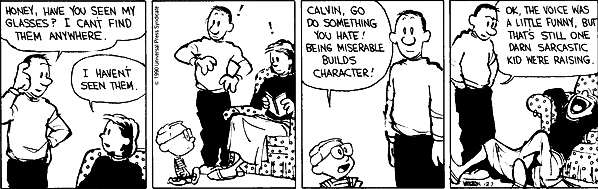
    This is a tough one.  If we are lucky, we are doing what we want to do for the majority of our waking hours, making the occasional push to do something unpleasant (but beneficial) a little easier.  If we aren't so lucky, we spend a lot of time (perhaps at work or in school) doing something we don't really want to be doing.  I am always reminded of the dad from the Calvin & Hobbes cartoon, who is constantly trying to get Calvin to do something he doesn't want to because, "...it builds character."  At the risk of sounding like a parent, that guy was onto something.  In fitness, we tend to do the things we enjoy doing.  I became a runner basically because I hated running.  Yes, that's counterintuitive.  I've been athletic and active my entire life, but I wanted a new challenge that fit into my current lifestyle - running fit the bill.  Sandwich one thing you don't like (say, Mountain Climbers) between some things you do like (front squats and Turkish Get-Ups, obviously) - you get the idea.  You will find there is a special satisfaction in completing something you're not thrilled about doing in the first place.

       Source.

*  Once in awhile, don't do something when you do want to.
    I put this in here as a reminder that recovery is important.  While for some of us the issue is not moving enough, for others the issue is slowing down.  Running through injury, lifting when sick, or just plain working out every day of the week without a break will only lead to breakdown in the end.  Go have fun!  Yes, working out can be fun.  Go do something else that is fun (Dear Red Sox, Please feel free to help me avoid injury by giving me tickets to a game a week so I have something fun to do other than working out.  Love, Me).  Speaking of fun...

*  Make a commitment... to doing something FUN.
    In reading through my list of the first four, it sounded a bit like a manifesto on how not to enjoy life!  Nobody wants to be forced to do something they don't like or that is hard all the time.  Likewise, we don't want to take away the things we enjoy.  That's why working activity into your life in ways that bring other forms of enjoyment is important.  I could run just to run - for the health benefits or whatever.  But, I run road races because I get further enjoyment out of the inner (and occasional outer) competition, the camaraderie of "we're all in this together" and the social aspect of having a post-race pint.  Beyond running, this activity brings me joy.  Do exercise and fun coexist in your life?

I opened the blog saying that balance is the best form of prevention.  Living a balanced life will enable you to stay healthy and realize your full potential.  Work and play.  Activity and rest.  Flexibility and strength.  Mobility and stability.  We need all of these things to be complete.

On a personal note, the last few weeks have been a bit of a roller-coaster in the lives of people I know.  Two untimely deaths have been met with a birth and a wedding - and with these events I have witnessed utter despair and unbounded joy.  In this moment I am thankful for the people I love and who love me, for the opportunities I have and create, and for the ability and drive to be better and move forward, however incrementally.  As my RoadID says, "Momentum trumps inertia."

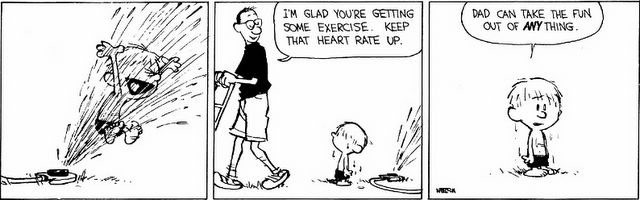
I thought I'd leave you with another Calvin and Hobbes strip!
"Grown-ups play by justifying it as exercise and keep tabs by quantifying performance."  Source.

Monday, March 7, 2011

How My Warm-Up Saves My Ass (Literally)

A little while ago, I was browsing the interwebs, and I stumbled on this article: "When the Diagnosis is 'Dead-Butt Syndrome'".  After the obligatory giggle, I read through author Jen Miller's account of being diagnosed with gluteus medius tendinosis, sometimes referred to as "dead-butt syndrome."  With or without the -osis (indicating an inflammation of the tendon sheath) attached to it, gluteus medius weakness is absurdly common in endurance athletes - particularly those who do only one sport, and especially in runners.  The third paragraph nails it: "It's a symptom related to what running experts hammer at: the need for cross-training and strength training."

Which brings me back to the Hyannis races that went on last weekend.  Prior to the race, I was doing a dynamic warm-up.  I find that I am always the only person doing this, and I get a lot of funny looks (it's okay, I'm used to that).  Some people "warm-up," of course, by static stretching and running around a bunch to get the blood flowing and practice their stride.  As far as neuromuscular facilitation, or movement preparation, or functional movement warm-ups, though, it is non-existent.  One experienced runner commented, "Um... you make me feel like I should be doing something.  I don't warm up.  I just run."  Another wandered by while I was doing body-weight squats and said, "The real challenge is to see if you can still do those after the race!" (Result: I could, though not without some grimacing).

There has been increasing coverage in the general media about the dangers of specialization, especially in children, and how doing one thing all the time can lead to very serious injuries.  Runners for some reason think they are immune to this, and I have yet to understand why because they are plagued with injuries. Now, I am new to this whole "being a runner" thing, so maybe I just haven't drank the Kool-Aid yet.  However, my background is in athletics, injury, biomechanics and sport training.  I would never assume to know everything about anything, but I've had a pretty solid success rate at both preventing and treating injuries in many clients. The ultimate test, though, is with myself.  How many self-proclaimed experts do we know who don't actually practice what they preach?  Heck, I'm guilty from time-to-time (Ice cream before bed?  Yes please!)!  But, on this front, I'm one of the best - the only injuries I've ever sustained were spraining each ankle once, and both were because I fell down a flight of stairs (yes, each ankle once, fell down stairs on two separate occasions... because you can't strength-train the "klutzy" out of your DNA).  I have never sustained a major competition- or training-related injury (though I *have* sustained a "lack of training" injury in my two bulging lumbar discs... more on that some other time).

How do I do it?  What magic elixir am I taking??  It must be L-glutamine, right?  Or glucosamine?  Or protein shakes?  Or maybe I just don't train that hard - that must be it, right?

Wrong!  Though I may not be running marathons right now, guess what?  You don't have to be training for a marathon to get hurt... but you knew that.

The best part is, it's simple - and I'll give it to you right here.  I am currently training for both running and cycling events.  I run three days a week at steady mileage to maintain the gains I've made, but I don't need to increase right now because I am not training for a farther distance than I've yet achieved.  I bike three days a week at varying, progressively longer distances.  These activities overlap on one day, so I train 5 days a week with two for "rest," but that is an active rest - these are days when I am working both jobs and just don't have time to get a run or bike in, but since one job is at a gym, I am able to do a few basic movements for recovery.

With all that time for training, it sounds like there's not a lot of time for that all-important cross-training I've been harping about, right?  And that's where the warm-up comes in.  One part Renegade Training, another part Mike Boyle Strength and Conditioning, I spend between 15 and 40 minutes (depending on the day and the activity) getting my body ready for what I'm about to do.  The major takeaway here: nearly all these exercises emphasize hamstring development and the "turning on" of the gluteal muscle group.  Why does this matter?  I'll tell you in another blog.  For now, the components of my warm-up:

*  Foam Roller - Don't leave home without it!!  I spend between 20-30 seconds each on my glutes, hamstrings, thoracic spine, IT bands, hip flexors/quads and adductors.

*  Posterior chain activation and core strength - Variations of bridges, tables, planks and Supermans (with a few push-ups thrown in) to get my core activated and ready to stabilize my hips, pelvis and back during my bike/run.

*  Dynamic ROM (range of motion) - Split squats, lateral and transverse lunges, as well as single-leg body-weight Romanian deadlifts and body-weight sumo squat "stretches."

*  Movement Prep - Walking lunge progressions, skips, butt-kicks.

For more specific info, hit me up with questions.  Happy Training!!

Tuesday, March 1, 2011

Running Gently, Part 2: I Get (a great finishing time) With a Little Help From My Friends!

I successfully completed my first 10K!!  I slogged through the snow, slush and ice to cross the finish line in a dead-out sprint for an official time of 55:21 (my goal was under 56 min).  The photo above gives you an idea of the weather (a wet snow fell the entire time)... ahh, racing in New England.  And you better believe there were people out there in shorts and tank tops!

I could not have run as well as I did, however, without the help of a seasoned marathoner who paced me for the first 5 miles, until our routes split.  The concept of pacing has been a difficult one for me, particularly over rolling hills where I want to charge up them, just to get them over with.  I use this approach in cycling a lot, but the difference is that you can't stop pedaling and coast for a bit when your feet are your wheels.  So, my "Run Sherpa" kept us around a 9-min pace, which she seemed to just know intuitively - something I don't quite understand but am thoroughly amazed by.  Practice, practice...

So, how was my form?  Did I "run gently?"  What does that even mean??

If you were trying to sneak up on somebody, how would you approach them?  Perhaps on the balls of your feet, carefully stepping to make as little noise as possible?  While good runners aren't exactly tip-toeing along, they are using the balls of their feet and their toes to drive them forward, and they are quiet.  Start listening when people run by you, or you are out running.  Is there a shuffle sound?  Does the shoe slap the ground (mine does, but I'm working on it...)?  Or is it nearly silent?  Gentle, and efficient, runners - even those who have not perfected that gazelle-like, beautiful form we all long for - are very quiet with each step.  Heel- or midfoot-striker, it will not matter.  They will breeze over the ground like they are floating.

Which brings me to the next aspect of gentle running: translation direction.  Most daily activities find us moving in some combination of the planes of movement, but in running, one of these should be dominant.  The goal of endurance running is simply to propel oneself straight forward in the most efficient way possible.  There is an important word in that sentence: forward.  Bipedal locomotion - walking and running forward - is what we have evolved to do.  And, yet, sometimes we are so bad at it!  It's almost as if we want to make it more complicated, or more exciting.  "It can't just be, 'Go forward,' can it?  There's gotta be more to it."  No, there isn't.

Why am I harping on this?  Because a huge tenet of running gently is running forward - NOT up-and-down.  I just watched some of the NFL Combine where I caught the linebackers doing the 40-yd dash.  Once these athletes were out of the starting gate, you could have put a roof an inch above their heads and they would never touch it.  When the goal is forward, up-and-down is wasted energy.  However, it is a common "coping mechanism" among novice distance runners.  My educated guess is that it's an unconscious way of pacing themselves.  Whereas fully forward motion might be too fast for the distance they are running, adding the "bounce" to their step is certainly going to slow them down - but it is also going to hemorrhage energy and possibly lead to injury.  This is a problem I am very familiar with.  As I mentioned previously, it is only recently that I have figured out a way to slow myself down without completely changing my biomechanics (smaller strides, increased frequency).  Prior to that, I was running with a sprinter's form and trying to keep a 10K pace, but I would fatigue after 2 miles because I was always running faster than I should have been.  And a long, long time ago, I was the bouncer - using my legs to absorb energy (and eat speed) by flexing my knees with each foot strike, making every step a poorly performed mini squat I would have to rebound from as I tried to continue forward.  No wonder I thought I wasn't built for this sport!

So, to run gently, we must 1) tread quietly, 2) pace ourselves with the right cadence and stride length for our body type and the distance we are running, and 3) go forward.

Pay attention to those three things on your next run (or while your athlete/client/friend/significant other/neighbor/stalking target is out for their run) and see what you come up with.  Do you run gently?

In the next few posts: How my warm-up saves my ass (literally); Prevention is the best injury treatment; Point/Counterpoint, where I argue with myself about orthotics and minimalism.  Stay tuned!

Wednesday, February 23, 2011

Running Gently, Part 1

Two things happened yesterday:

First, I ran 4.3 miles.  This is (sad to say) the farthest I have ever run consecutively.  As in, I didn't stop, I did it on purpose, and I did it as a part of my training for the 10K I have Sunday and my eventual half marathon.  I also did it outside - I don't have access to a treadmill right now, so I'm out pounding the pavement, no matter what the weather.  Turns out today was quite nice, despite not getting very far into the 20's (that's below-zero in Celsius, for all my international readers!).

Second, I started my new internship at a footwear company.  It will not be possible to convey my excitement about this.  For the next 3-6 months, I work in the sports research lab, where I will learn everything I could have ever hoped to know about shoes and shoe construction.  I literally use a saw to cut shoes in half, and then in half again, in an effort to understand what goes into their construction, right down to the last detail (pun intended, for those who know shoes).

What does my day have to do with running gently?  Well... everything.

In addition to the actual research that comes out of a corporate sponsored research lab, it's a pretty neat stop on any guided tour.  Apparently this happens all the time, and yesterday was no exception, as we hosted a large group who does business with the shoe company.  While they are being shown the lab's capabilities, they have the opportunity to ask questions.  One astute participant asked about running form, and if the lab had any empirical data to support the superiority of a mid-foot foot-strike.

My colleague's response so so well-put I found myself wishing I'd had a video camera set up to capture it.  In essence, the research lab has not yet had the opportunity to assess the "superiority" of any particular gait pattern.  A quick review of th available literature suggests that not many others have attempted to answer this question in any resounding manner, either.  He continued, (and of course I am paraphrasing) "The variability of each individual's body type, morphology and individual physical characteristics probably means that there is not any one way that is the right way to run.  This is true of all our research.  When we created (a product), we wanted to know, how does this feel to a majority of people?  Not, 'Does this work for everybody?', because nothing will never be right for everybody.  But, can we manage to provide something for the majority of people who might be interested in it?"

Another colleague chimed in, citing Christopher McDougall, who I referenced in my last blog post.  He mentioned how in McDougall's case, he had tried many, many different options to run comfortably and without injury, all to no avail.  "In his situation, where he has tried just about everything without any success, well then maybe it makes sense to do something completely different - like run barefoot, or in minimal shoes."

While it is a virtual certainty that there is not one correct way for everybody to run (the concept of variability), it is equally likely that it is possible to change your running form (the concept of adaptability).  In fact, it is already known that, like any exercise program, a running program designed to specifically alter your gait in one way or another can be successful - and the empirical evidence will probably be published to back it up soon.  Once again, while this may not be the right idea for *everyone*, it is probably a good idea for some people.

Like me, for instance... which brings me to yesterday's run.  I have always been a sprinter (see my first blog where I begrudgingly admit to transitioning into being a "runner" now).  I train for power.  I know that the more force I put into the ground, the more ground reaction force I get out of it - the harder I push off the ground, the higher I can jump.  Unfortunately, this has not translated well for distance running.  My feet slap the ground with the grace of a drunk clown chasing down children.  My strides are long, because I am used to having short bursts of speed and reaching with my feet, as you do while dribbling a soccer ball (pushing it out in front of you) or challenging an opponent.  These techniques lead to some serious inefficiencies when it comes to endurance training.  Thus, I have consciously worked on adjusting my stride to one that allows me to run longer without sacrificing too much in speed.

In this way, I borrowed the methodology of cyclists, a sport which I am a bit more familiar with (and better at, if only marginally).  Lance Armstrong, among others, advocates using higher gears ("easier") and an increased tempo, somewhere around 90 beats a minute (45 revolutions per foot).  With this in mind, I shortened my stride and increased my tempo - hitting the ground more often but not traveling as far with each step.  I haven't broken down the biomechanics of it yet, but so far it's been successful cardiovascularly.  I can run farther, with roughly the same overall pace, but my heart rate stays lower and I don't feel as "gassed" as I typically do, especially on hills.  My legs also feel stronger throughout the entire run.  In some way, I have found an efficiency increase.

I practiced this on yesterday's run, with great success.  However, by the time I was finished I was having terrible hip pain over both my IT bands and in my right hip flexor (where I've had previous trouble).  I believe it leads back to the concept of "running gently."  Though I promised a conclusion to this discussion in my last post, I will have to put it off for one more entry... I don't want to be late for my other job!

Next time:  Landing postures, warm-up and strength training... How these things have helped me be successful and injury-free.

Saturday, February 19, 2011

"Proper" Running Form?

I've had the flu for 6 days, and I am happy to report that I am finally on the mend.  Fortunately, I was sick during a week where my work schedule was light and I had a lot of free time.  Unfortunately, I had planned on using that free time to train for my upcoming 10k in Hyannis next weekend.  Next week I am starting two new jobs... and still working the old job.  That means that when I run the 10k, the farthest training run I will have logged is 3.6 miles, and it was over two weeks before the actual race.  While this is not a training mechanism I would recommend to anyone (and one I will not employ in the future), I am nonetheless going to run the race, come hell or high water!!  I may not finish in record time, but I will finish.

In the meantime, I wanted to build on my last blog, where I started to discuss proper running form.  As I mentioned, running shoes have taken a lot of blame for the gait of many of today's athletes.  As Townsend pointed out in the article I linked to, until very recently all athletic shoes were built with cushioned heels that were designed to reduce impact forces during heel striking.  This leads to a "chicken-or-egg" scenario: Did running shoe companies provide cushioned heels because athletes were hurting themselves while heel striking and needed such cushioning?  Or did athletes begin heel striking with the creation of shoes that allowed them to do so?

Before I answer this question, I want to point to another blog post, by RunBlogger's Pete Larson.  Larson is a biologist, and in his post, he brings up a point that anyone who has ever done a science experiment is familiar with: variability.  As a biologist, Larson has come across variability in his research, and his knowledge of the world around us leads him to believe that the same variability he finds in other organisms probably exists in humans.  He is, in fact, correct.  While we often hear that there is one "correct" way of doing something (for instance, how to squat), the truth is that humans have a high amount of variability between them, and even within them.  In the RunBlogger post, there is a video of 4 of the top 5 finishers at the 2010 Boston Marathon.  Even among these elite runners, there is variability in all aspect of their gait.

Back to the heel striking question: were shoes designed because we were heel strikers, or did we become heel strikers because of the way shoes were designed?  A quick personal anecdote gives you my answer.  I have used a wide variety of athletic footwear in my life, at one point wearing orthotics and motion-control shoes, and at others wearing minimalist shoes.  All other factors aside, when I run in minimalist shoes (ones with no cushioning or drop, like the Vibram Five-Fingers), I am physically unable to run with a heel-strike.  Simply put, I'd break my calcaneus (or at least bruise it really badly).

So, most people were probably running with a mid-foot or fore-foot strike prior to the introduction of cushioned athletic shoes.  *But,* and this is important, how do we know that this was the "correct" running form?  Just because it was how people were running before technology allowed them to change does not make it the "right" way - it was the only available way.  There was no other choice!  Could it be possible that, at least for some people, heel striking is actually a more natural running pattern, and these shoes now allow these people to run more comfortably?

Many people point to Christopher McDougall's book Born to Run and the story of the Tarahumara, a people left untouched by modern society.  In short, without any modern amenities whatsoever, a tribe of people run as their only means of transportation, sometimes hundreds of miles a week.  Despite the fact that they live in the woods and have little more than rawhide to cover the soles of their feet, running injuries and "overuse" injuries are nonexistent.  McDougall has made a career out of the idea that going barefoot is the way to freedom - freedom from pain, injury and the cost of useless technology that is, at best, not helping us and at worst, actually causing injuries.

Could there possibly be another explanation for all this?  The Tarahumara run.  That's what they do - that's how they get around.  Seems pretty obvious that they would have adapted well to not getting injured from running when that's how they survive.  But you and me?  We run for fun.  I'm willing to bet that while awake, dear reader, you spend at least 50% of your time seated (and the only reason I'm not guessing higher is that I know some pretty active people).  Do you work on a computer?  Drive a car?  We ALL do.  It's a part of modern life!  And guess what, there are consequences for our bodies that come along with that.  Just like our bodies would adapt if we ran all day, every day, our bodies have adapted to being awfully sedentary.  Though I am not saying this is a good thing, I am saying that along with variability between and within individuals, I can also guarantee the human body's ability to adapt.

So.  We've been running in cushioned shoes for roughly 40 years.  We've been in increasingly sedentary jobs for about the past 30 years.  We've moved from an industrial economy to... whatever it is we are now - certainly, computer-based and consumer-driven, but certainly not factories and brick-and-mortar.  Does anyone personally know a farmer?  Does that farmer hoe his own land, or does he ride a giant tractor?  You get my drift.  Could it be possible that our running form - whatever our personal running form might be - has degraded due to a confluence of factors?  Even McDougall says, "But ultimately, the debate isn't about Bare Soles vs. Shoes.  It's about learning to run gently.  Master that, and you can wear - or not wear - anything you please."

More on running gently in the next post...

Friday, February 18, 2011

Winter Lightning

I've lived in the Northeast for all but 4 total years of my life, and this is the first time I can remember a thunder-and-lightning storm in the middle of February. I am sitting here in the dark, watching the storm out my back windows - admittedly, jumping out of my skin with every flash that lights up the night sky (I have an irrational fear of lightning, and I would prefer to be hanging out with my cat right now, who has sought refuge from the storm under my bed).  There is something brilliant about such a powerful display of energy in the form of weather.  The lightning and thunder have retreated now, and - as always - the emergency sirens rise in the distance.

This seasonal anomaly had me pondering other things that don't make sense.  For instance, the preposterous amount of injuries sustained in non-contact situations by runners.  OK, the storm didn't directly lead me to think about hurt runners - this article did.

The author, John Converse Townsend (a somewhat ironic name, given who he is upset with), takes aim at the footwear industry, joining the growing legions of voices who place blame for poor running technique and the host of injuries that accompanies it square on the shoulders those who design and manufacture athletic shoes.  I do not wish to echo his sentiments here - you can read what he has to say, as he put it quite succinctly.  However, I would like to highlight one aspect of his article.

Townsend discusses running form during basketball games.  This is an important, and significant, departure from the current conversation about running that is entirely about, well, runners.  But what about the millions of athletes who run as a part of their sport?  Basketball, soccer, lacrosse, field hockey, rugby, American football - these are just a few of the sports in which running is required for success, but is not the actually the primary goal of the athletic event.

So, what if we're (mostly) all doing it wrong?  Shoes may play a role in this.  Townsend's article quotes a colleague of mine, Dr. Irene Davis, who gamely states, "We've seen tremendous innovations in motion control and cushioning.  And yet the remedies don't seem to defeat the ailments."  Does this mean the shoes are actually the problem?  While I am convinced that the footwear industry has not lived up to the hype in terms of providing the promised benefits of shoes that cost half my weekly salary, I am not yet convinced that said shoes are actually the culprit - or, at the very least, the *only* culprit.

That said, this idea of improper biomechanics strikes a chord with me.  In an era where most business is conducted from a seated position and activity is not the norm, it is not surprising that something about our gait may have changed.  In the interest of brevity (and the fact that I am still fighting the flu and would like to go lay down now), I will explore this issue more in another post.

Until then, have fun doing something active!

Wednesday, February 16, 2011

Confessions of a Reluctant Runner

I am a runner.

I wince at the sight of that sentence.  A fitness professional I know asked me recently about sports I used to do. He followed it with, "And now you're... a runner?"  The hesitation, and the slight trace of a smirk that played at the side of his mouth gave away his feelings on "runners."

I am a runner.

Truth is, I was once probably worse than he was about "runners."  I still harbor many of the feelings I did previously, and with good reason.  I have dealt with self-proclaimed runners, of both the competitive and casual collection, in various settings for years.  Here is what I have learned: They are nearly always hurt.  Runners, as a group, seem to have the highest incidence rate for chronic, nagging injuries.  Maybe this makes intuitive sense - they engage in exercise that is of a chronic, nagging variety (you can see how thrilling I think running is).  But something about runners, and the injuries they sustain, is different.  No athlete who is serious about his or her sport is going to want to take a day off, even if it means the chance to be better, longer.  Nearly all athletes are hard-wired to want to go, push, practice, participate - this is one of the greatest challenges of working with athletes.  But runners... they are another animal entirely.  I once asked a runner to please, please take the day off from running to let some Achilles inflammation calm down.  He proceeded to run 3 miles, only to return and tell me that he DID take the day off.  And you know what?  He truly believed that running 3 miles was "a day off."

I am a runner?

Okay, I am not *that* kind of runner, and let's be honest, I'm never going to be.  For the first 29 years of my life, running was something you did out of necessity, as a part of something else.  You ran to first base.  You ran the length of a soccer field.  You ran to catch the T.  Thus, my running was mostly of the sprinting variety. I scoffed at distance runners.  Who the heck wants to pound pavement for hours on end, only to end up injured?  What's the point?  Where is the goal-scoring?  Where is the team you are benefiting?  I smirked at athletes who used jogging as a training mechanism.  I couldn't wait to show them how they were training themselves to be slower.

But, now I am a runner.

Nearly every sport I've ever participated in, from soccer to softball to pick-up dodgeball games, has had an explosive component to it.  Thus, I have always trained for explosive power and speed.  I am at home under an Olympic bar.  I live to single-leg box jump.  I find joy in repeated sprints, pushing myself to be faster every time.  About a year ago, though, I realized that it had been quite some time since I had actively participated on a sports team.  What, exactly, was I training for?  I was becoming the gym-rat I abhor - the person who is in the gym, and is "fit," but for what purpose, exactly?  To be better at being in the gym?  Ugh.  I needed a goal.

Enter: cycling.  (Gotcha.  You thought I was going to say running).  When someone very close to me was diagnosed with Multiple Sclerosis, I did the only thing that felt like helping - I bought a bike, organized a team, and did the MS 150 Ride in South Florida.  I actually fell in love with cycling.  It was the first time I experienced any sort of joy while doing an endurance-type sport.  Eventually, I figured that if I could transition into cycling with such enthusiasm, maybe it was time to give running another chance.  After all, I'd never run with a purpose (apart from not keeling over while slogging through some pre-determined distance that would be considered a successful "workout" for the day in the years before I knew better).

So, here I am.  I have signed up for several races (mostly 5Ks and one 4-miler) over the past few months.  It's been... interesting.  I don't love it - not yet.  But I'm giving it a chance.  I'm doing my first 10K in a week and a half.  I plan to do a half marathon this year - two weeks before my 30th birthday.  That's the plan.  I needed to have goals again, and now I do.  The thing is, it's not a competition - the only "competition" is with myself, something I've never really found that motivating.  Where's the team you don't want to let down?  Where are the fans you want to do well for?  This purpose of this blog is two-fold: First, put this experience out there.  My "team" will be the people who read this and relate, or at least feel like they come away with something new.  Second, say it with me now, accountability.  I've worked in the fields of rehabilitation and fitness long enough to know that without accountability, every goal is harder to attain.  So, I put this out into the interwebs as my way of saying, "I will do what I say I will do."  Half-marathon, here I come.

Because I am a runner.